
 ID
ID  EN
EN 
16 Tenses bahasa Inggris adalah bentuk perubahan kata kerja (verb) yang menunjukkan waktu terjadinya suatu peristiwa dan tingkat penyelesaiannya. Tenses terbentuk dari kombinasi 4 waktu (Present, Past, Future, Past Future) dan 4 aspek (Simple, Continuous, Perfect, Perfect Continuous). Rumus paling dasarnya berakar pada pemakaian Verb 1 (saat ini), Verb 2 (lampau), Will + V1 (masa depan), dan Verb 3 (selesai/sempurna).
Di artikel ini, kamu bisa mencari tahu lebih dalam soal tata bahasa yang sering digunakan dalam bahasa Inggris, misalnya 16 tenses bahasa Inggris yang mungkin dianggap sulit oleh banyak orang. Mempelajari bahasa baru memang butuh ketekunan dan kerja keras, tapi nothing is impossible kalau kamu punya tekad yang kuat.
Yuk, simak uraian di bawah!
Daftar Isi
- Apa Fungsi Tenses Dalam Bahasa Inggris?
- Rangkuman Singkat 16 tenses Bahasa Inggris Untuk pemula
- Present Tense (Simple, Continuous, Perfect, Perfect Continuous)
- Past Tense (Simple, Continuous, Perfect, Perfect Continuous)
- Future Tense (Simple, Continuous, Perfect, Perfect Continuous)
- Past Future Tense (Simple, Continuous, Perfect, Perfect Continuous)
- Cara Cepat Mengerjakan Soal Latihan Tenses Bahasa Inggris
- FAQ 16 Tenses Bahasa Inggris
Apa Fungsi Tenses Dalam Bahasa Inggris?
Menurut British Council, tenses dalam bahasa Inggris berfungsi sebagai penanda waktu untuk suatu aksi atau kejadian menggunakan 12 struktur kata kerja.
Secara umum, tenses memiliki kaitan yang sangat erat dengan waktu kejadian. Tenses juga bisa digunakan untuk;
- Mengetahui kapan suatu kejadian terjadi,
- Mengatahui durasi terjadinya suatu kejadian, dan
- Menunjukkan hubungan waktu yang menghubungkan satu kejadian dengan yang lain.
Ada 16 tenses dalam bahasa Inggris yang bisa kita pelajari bersama. Di bawah ini, kamu bisa mempelajari rangkuman dasar 16 tenses bahasa Inggris tersebut.
Rangkuman Singkat 16 tenses Bahasa Inggris Untuk pemula
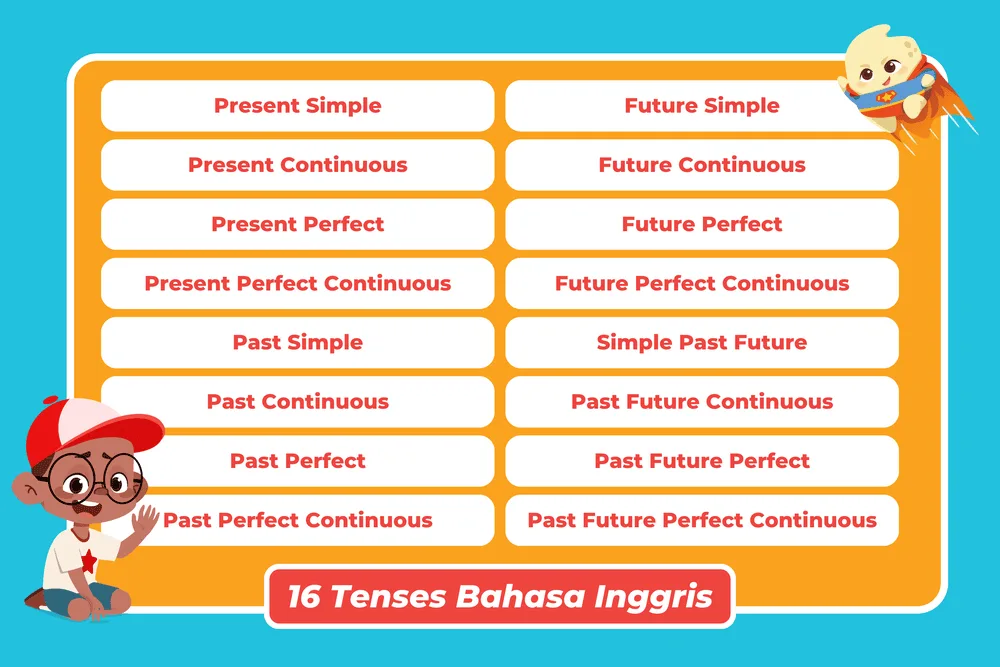
16 tenses bahasa Inggris punya fungsi dan rumus tenses masing-masing. Di bawah ini, kita bisa belajar bersama lewat rangkuman singkat mengenai 16 tenses bahasa Inggris.
| No | Tense | Rumus Kalimat Verbal (+) | Keterangan Waktu (Time Signal) | Contoh Kalimat Singkat |
| 1 | Simple Present | S + V_1 (s/es) | always, usually, every day | She writes a letter. |
| 2 | Present Continuous | S + is/am/are + text-ing | now, right now, at present | She is writing a letter. |
| 3 | Present Perfect | S + have/has + V_3 | already, yet, since, for | She has written a letter. |
| 4 | Present Perfect Cont. | S + have/has + been + V text-ing | for 2 hours, all day | She has been writing for hours. |
| 5 | Simple Past | S + V_2 | yesterday, last night, in 2020 | She wrote a letter. |
| 6 | Past Continuous | S + was/were + text-ing | when, while, at 7 PM yesterday | She was writing when he arrived. |
| 7 | Past Perfect | S + had + V_3 | before, after, by the time | She had written before he arrived. |
| 8 | Past Perfect Cont. | S + had + been + V text-ing | for 3 hours before… | She had been writing for 3 hours. |
| 9 | Simple Future | S + will + V_1 | tomorrow, next week, soon | She will write a letter. |
| 10 | Future Continuous | S + will + be + V text-ing | at 9 AM tomorrow | She will be writing tomorrow. |
| 11 | Future Perfect | S + will + have + V_3 | by next month, by 2027 | She will have written the book. |
| 12 | Future Perfect Cont. | S + will + have + been + V text-ing | by next year for 5 years | She will have been writing for years. |
| 13 | Past Future | S + would + V_1 | if, should, that day | She would write if she could. |
| 14 | Past Future Cont. | S + would + be + V text-ing | at that time (past plan) | She would be writing at that time. |
| 15 | Past Future Perfect | S + would + have + V_3 | if clause type 3 | She would have written it. |
| 16 | Past Fut. Perf. Cont. | S + would + have + been + V text-ing | past conditional duration | She would have been writing. |
Present Tense (Simple, Continuous, Perfect, Perfect Continuous)
Simple Present
Simple present tense digunakan untuk menyatakan kebiasaan (habitual action), rutinitas, dan fakta umum ilmiah (general truth).
Rumus simple present tense;
| Rumus: | Contoh Kalimat: |
| (+) S + V1 (he, she, it + V1+s/es) | (+) She works every day. |
| (-) S + do/does + not + V1 | (-) He does not play football. |
| (?) Do/Does + S + V1? | (?) Do you like coffee? |
Time Signals: always, usually, often, sometimes, seldom, never, every day, every week.
Present Continuous
Present continuous tense biasanya digunakan untuk menyatakan tindakan yang sedang berlangsung saat ini atau rencana di masa depan.
Rumus tenses present continuous terdiri dari;
| Rumus: | Contoh Kalimat: |
| (+) S + am/is/are + V-ing | (+) I am reading a book. |
| (-) S + am/is/are + not + V-ing | (-) They are not working today. |
| (?) Am/Is/Are + S + V-ing? | (?) Are you studying right now? |
Time Signals: now, right now, at this moment, currently, Look!, Listen!.
Present Perfect
Biasanya, tenses present perfect digunakan untuk peristiwa yang terjadi pada waktu yang tidak spesifik di masa lalu dan hasilnya masih relevan, atau tindakan yang baru saja selesai.
Begini rumus present perfect tense;
| Rumus: | Contoh Kalimat: |
| (+) S + has/have + V3 | (+) She has visited the museum. |
| (-) S + has/have + not + V3 | (-) I have not seen that movie. |
| (?) Has/Have + S + V3? | (?) Have they finished their homework? |
Time Signals: already, yet, just, ever, never, since, for, recently.
Present Perfect Continuous
Jenis tenses yang satu ini digunakan untuk menunjukkan tindakan yang dimulai di masa lalu dan masih berlanjut sampai sekarang.
Rumus present perfect continuous;
| Rumus: | Contoh Kalimat: |
| (+) S + has/have + been + V-ing | (+) They have been working for hours. |
| (-) S + has/have + not + been + V-ing | (-) She has not been feeling well. |
| (?) Has/Have + S + been + V-ing? | (?) Have you been waiting long? |
Time Signals: for two hours, all morning, since morning, the whole day.
Past Tense (Simple, Continuous, Perfect, Perfect Continuous)
Simple Past
Simple past tense punya fungsi untuk menyatakan tindakan yang sudah selesai di masa lalu.
Rumus simple past tense adalah:
| Rumus: | Contoh Kalimat: |
| (+) S + V2 | (+) I visited New York last summer. |
| (-) S + did + not + V1 | (-) He did not go to the party. |
| (?) Did + S + V1? | (?) Did you watch the movie? |
Time Signals: yesterday, last night, last week, two days ago, in 2020, just now.
Past Continuous
Fungsi dari past continuous tense adalah untuk menyatakan tindakan yang sedang berlangsung di masa lalu pada waktu tertentu.
Begini cara membuat kalimat past continuous tense:
| Rumus: | Contoh Kalimat: |
| (+) S + was/were + V-ing | (+) She was reading when I called her. |
| (-) S + was/were + not + V-ing | (-) I was not studying last night. |
| (?) Was/Were + S + V-ing? | (?) Were you sleeping when I called? |
Time Signals: when, while, at 7 PM yesterday, all evening yesterday.
Past Perfect
Jenis tenses yang satu ini biasa digunakan untuk menyatakan tindakan yang sudah selesai sebelum tindakan lain di masa lalu.
Lihat rumus past perfect tense dan contoh kalimatnya di bawah ini ya!
| Rumus: | Contoh Kalimat: |
| (+) S + had + V3 | (+) They had left before I arrived. |
| (-) S + had + not + V3 | (-) I had not finished my homework when he called. |
| (?) Had + S + V3? | (?) Had you eaten before the meeting? |
Time Signals: before, after, by the time, as soon as, already.
Past Perfect Continuous
Penggunaan past perfect continuous tense ditujukan untuk menunjukkan tindakan yang telah berlangsung sebelum kejadian lain terjadi di masa lalu.
Ada tiga jenis rumus yang harus kamu pelajari, di antaranya;
| Rumus: | Contoh Kalimat: |
| (+) S + had + been + V-ing | (+) She had been working for hours before she took a break. |
| (-) S + had + not + been + V-ing | (-) They had not been studying for the exam. |
| (?) Had + S + been + V-ing? | (?) Had you been waiting long when they arrived? |
Time Signals: for three hours before…, since morning until….
Future Tense (Simple, Continuous, Perfect, Perfect Continuous)
Simple Future
Fungsi simple future tense adalah untuk menyatakan rencana atau prediksi di masa depan.
Berikut adalah beberapa rumus dasar yang bsia kamu gunakan untuk membuat kalimat simple future tense:
| Rumus: | Contoh Kalimat: |
| (+) S + will + V1 | (+) I will visit you tomorrow. |
| (-) S + will + not + V1 | (-) She will not attend the meeting. |
| (?) Will + S + V1? | (?) Will you come to the party? |
Time Signals: tomorrow, next week, soon, later, in three days.
Future Continuous
Future continuous tense berfungsi untuk menyatakan tindakan yang akan sedang berlangsung pada waktu tertentu di masa depan.
Rumus future continuous tense:
| Rumus: | Contoh Kalimat: |
| (+) S + will + be + V-ing | (+) I will be studying at 8 PM. |
| (-) S + will + not + be + V-ing | (-) We will not be traveling next week. |
| (?) Will + S + be + V-ing? | (?) Will they be working tomorrow? |
Time Signals: at this time tomorrow, at 9 AM next Monday.
Future Perfect
Future perfect biasanya digunakan untuk menyatakan tindakan yang akan selesai sebelum waktu tertentu di masa depan.
Rumus future perfect tense:
| Rumus: | Contoh Kalimat: |
| (+) S + will + have + V3 | (+) By next week, I will have finished my project. |
| (-) S + will + not + have + V3 | (-) She will not have completed her task by tomorrow. |
| (?) Will + S + have + V3? | (?) Will they have left by 5 PM? |
Time Signals: by next month, by the end of this year, by tomorrow.
Future Perfect Continuous
Future perfect continuous tense punya fungsi penting untuk menunjukkan tindakan yang akan sudah berlangsung sampai waktu tertentu di masa depan.
Jenis tenses yang satu ini punya struktur tenses sebagai berikut:
| Rumus: | Contoh Kalimat: |
| (+) S + will + have + been + V-ing | (+) By next year, I will have been working here for 10 years. |
| (-) S + will + not + have + been + V-ing | (-) She will not have been waiting for long by the time you arrive. |
| (?) Will + S + have + been + V-ing? | (?) Will you have been studying for 2 hours by 7 PM? |
Time Signals: by next year for 10 years, by tomorrow for 3 days.
Past Future Tense (Simple, Continuous, Perfect, Perfect Continuous)
Simple Past Future
Simple past future digunakan untuk menyatakan kemungkinan di masa depan jika kondisi tertentu terpenuhi. Rumusnya terdiri dari;
| Rumus: | Contoh Kalimat: |
| (+) If + S + present, S + will + V1 | (+) If it rains, we will stay inside. |
| (-) If + S + present, S + will + not + V1 | (-) If it rains, we will not go outside. |
| (?) If + S + present, will + S + V1? | (?) If it rains, will we stay inside? |
Past Future Continuous
Past fture continuous tense berfungsi untuk menyatakan kondisi yang tidak nyata atau tidak mungkin terjadi di masa depan.
Berikut adalah rumus-rumusnya;
| Rumus: | Contoh Kalimat: |
| (+) If + S + past, S + would + V1 | (+) If I were rich, I would travel the world. |
| (-) If + S + past, S + would + not + V1 | (-) If I were rich, I would not work. |
| (?) If + S + past, would + S + V1? | (?) If you were rich, would you travel the world? |
Past Future Perfect
Tenses yang satu ini memiliki fungsi untuk menyatakan kondisi yang tidak terjadi di masa lalu dan hasil yang seharusnya terjadi.
Ada beberapa rumus past future perfect yang bisa digunakan, antara lain;
| Rumus: | Contoh Kalimat: |
| (+) If + S + past perfect, S + would have + V3 | (+) If I had studied harder, I would have passed the exam. |
| (-) If + S + past perfect, S + would not have + V3 | (-) If I had studied harder, I would not have failed the exam. |
| (?) If + S + past perfect, would + S + have + V3? | (?) If you had studied, would you have passed the exam? |
Past Future Perfect Continuous
Fungsi past future perfect continuous tense adalah untuk menggabungkan kondisi di masa lalu dengan hasil yang relevan di masa sekarang.
Berikut adalah beberapa rumus dasar yang bsia kamu gunakan untuk membuat kalimat past future perfect continuous tense:
| Rumus: | Contoh Kalimat: |
| (+) If + S + past perfect, S + would + V1 | (+) If I had studied harder, I would be a doctor now. |
| (-) If + S + past perfect, S + would not + V1 | (-) If I had studied harder, I would not be struggling with my job now. |
| (?) If + S + past perfect, would + S + V1? | (?) If you had studied, would you be a doctor now? |
Cara Cepat Mengerjakan Soal Latihan Tenses Bahasa Inggris
Karena berkaitan erat dengan waktu, kamu bisa melakukan beberapa langkah
Berikut tips dan trick mengerjakan soal latihan tenses bahasa Inggris:
- Hapalkan kata penanda waktu dari masing-masing tenses,
- Fokus pada kata kerja (verb) untuk menentukan garis besar tenses,
| Tense | Bentuk Verb |
|---|---|
| Present | V1 / V1+s |
| Past | V2 |
| Perfect | have/has/had + V3 |
| Continuous | to be + V-ing |
- Perhatikan subjek dan struktur yang digunakan, dan
- Banyak berlatih
Baca juga: 50 Soal Latihan Present Tense Bahasa Inggris
FAQ 16 Tenses Bahasa Inggris
Ada beberapa pertanyaan yang sering diajukan pelajar tentang materi 16 tenses bahasa Inggris, di antaranya;
Tenses adalah bentuk kata kerja yang digunakan untuk menunjukkan waktu terjadinya suatu aksi (masa sekarang, lampau, atau masa depan) serta durasi dan hubungan antar kejadian.
Secara umum ada 16 tenses dalam bahasa Inggris
Tenses berfungsi untuk memperjelas keterangan waktu dari terjadinya suatu kejadian.
Kesimpulan
- Artikel membahas tentang 16 tenses bahasa Inggris yang penting untuk pelajar pemula.
- Tenses berfungsi untuk menunjukkan waktu kejadian dan hubungan antar kejadian.
- Pendahuluan tentang setiap tense mencakup rumus dan contoh kalimat.
- Kunci belajar tenses adalah latihan dan pantang menyerah.
- Sumber bacaan untuk memperdalam pemahaman tentang tenses juga disediakan.
Gimana, mudah kan? Kuncinya adalah dengan banyak berlatih dan pantang menyerah agar kamu dapat dengan segera menguasai tata bahasa Inggris tanpa kesulitan.

Mau belajar bahasa Inggris dengan kurikulum kelas dunia?
Di WonderMind, kamu nggak cuma dapat pengajaran dari kurikulum bergengsi, tapi juga pengajar bersertifikat dan native teacher yang siap membantu proses belajar kamu agar progresnya berjalan dengan baik.
Tunggu apa lagi? Yuk belajar di tempat kursus bahasa Inggris dan Mandarin terbaik di Jakarta!
Sumber bacaan: Verb Tenses.
Diperbarui tanggal 21 September 2026.